This is the third article summarising draft amendments for the DTIC’s B-BBEE Draft Codes of Good Practice. Refer to the previous article titled “B-BBEE Draft Codes of Good Practice and public commentary for draft statements – 29 January 2026 updates” for the initial detail.
The Draft Statement is accessible at the following hyperlink on the departmental website: https://www.thedtic.gov.za/wp-content/uploads/DraftStatement-103-of-2026.pdf
Items marked with “***” are additions or amendments. The controversial BEE “Transformation Fund” makes an appearance once again.
OBJECTIVES OF THIS STATEMENT
The objectives of this statement are to:
- Define the means by which Multinationals may apply for recognition of Equity Equivalent programmes; and
- Specify how contributing towards the Ownership element of Broad-Based Black Economic Empowerment (B-BBEE) by multinationals is measurable.
KEY MEASUREMENT PRINCIPLES
Any Equity Equivalent contributions towards the Ownership element of B BBEE made by multinationals are measurable against the value of their operations in the Republic of South Africa.
RECOGNITION OF EQUITY-EQUIVALENT PROGRAMMES
- The Minister may approve certain Equity Equivalent programmes after the multinational has consulted with the sectoral line ministry, premiers or other stakeholders in any government department, provincial government or local government with respect to their equity equivalent proposal.
- Any equity-equivalent programme forming part of a sector code constitutes an approved programme.
- Equity Equivalent programmes are preferably sector-specific, but the minister may consider requests for approval of programmes that are not sector-specific.
- Equity Equivalent programmes may involve projects that support government strategic economic development policies and programmes such as:
4.1 The Industrial Policy-related initiatives;
4.2 Black Industrialists Development Programme;
4.3 The National Skills Development Strategy; and
4.4 The National Development Plan.
4.5 Equity Equivalent programmes must promote and advance the following critical areas:
4.5.1 Enterprise Development [and], Supplier Development, and/or Transformation Fund
4.5.2 Research and Development; and
4.5.3 Critical and core skills.
- Multinationals may have any of the enterprises or natural persons stipulated below as beneficiaries of their equity equivalent programmes.
- If the beneficiaries of any programme stated under 3.4.6 above are enterprises, the following criteria will apply:
6.1 For Exempted Micro Enterprises, the enterprise must be a level one B-BBEE-compliant; and
6.2 For Qualifying Small Enterprises, the enterprise must be a level one B-BBEE-compliant enterprise.
- If the beneficiaries of any programme above are natural persons or designated groups or co-operatives or communities, the following criteria will apply:
7.1 The natural persons who are Black people must be at least 75% of the total beneficiaries;
7.2 The economic interest/benefit allocated to the beneficiaries must be at least 75%.
7.3 In the event that the beneficiaries are represented by a co-operative, then Black women own more than 30% of the co-operative.
- Equity Equivalent programme applications must include:
8.1 Full description of the programme objectives and projected outcomes;
8.2 Qualification criteria for participation in the programme;
8.3 Timelines for implementation and delivery with milestones against which progress is measurable; and
8.4 Details about the sponsors of the programme.
8.5 Equity Equivalent programmes are limited to multinationals subject to a global practice.
MEASUREMENT OF EQUITY-EQUIVALENT CONTRIBUTIONS ON THE OWNERSHIP SCORECARD
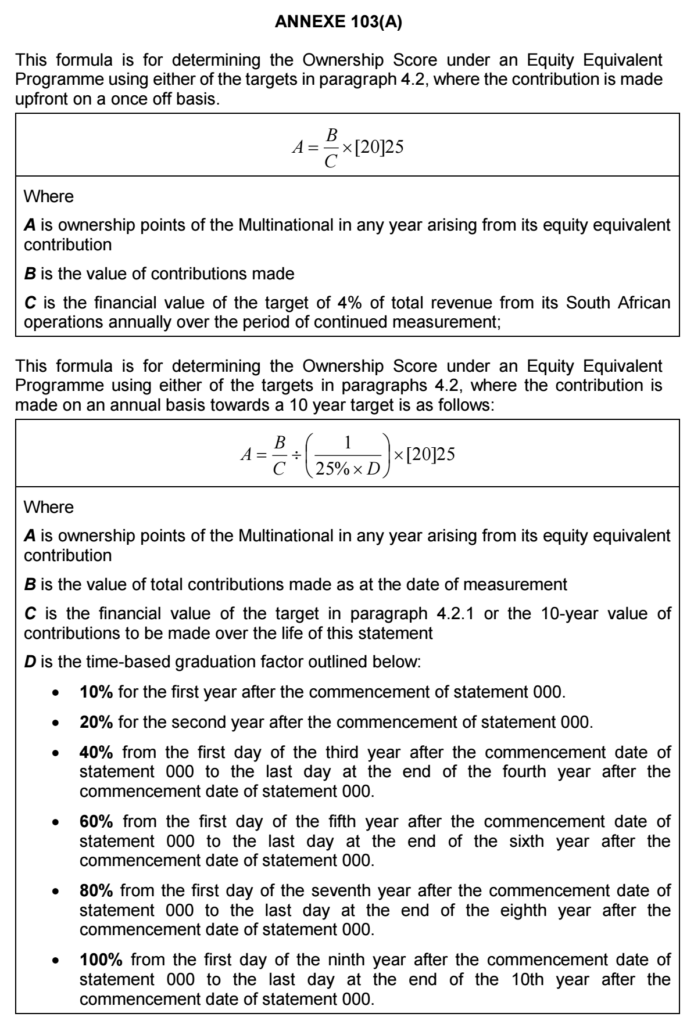
9.1 The ownership score of a multinational participating in an equity equivalent programme is calculated in terms of Annexe 103 (A). A multinational participating in an equity equivalent programme cannot receive any points for ownership under any statement in Code Series 100 other than this statement.
9.2 Contributions to Equity Equivalent programmes are measured as actual contributions made using the general principle set out in code series 400 and 500 against any of the following targets:
9.3 25% of the value of the South African operations of the Multinational, determined using a Standard Valuation Method; or
9.4 4% of total revenue from its South African operations annually over the period of continued measurement.
9.5 The Ownership Score under an Equity Equivalent programme using either of the targets above must be calculated in terms of Annexe 103 (A).
EEIP OWNERSHIP POINTS CERTIFICATE
- The EEIP Ownership Points Certificate awarded in terms of this statement and in particular paragraph three above will be valid for an investment period agreed upon below.
TOPPING-UP
- If a multinational wants to retain its EEIP Ownership Points at the date of expiry of its certificate in terms of paragraph six above, then the multinational will have to reinvest and make an additional contribution into a new Equity Equivalent programme using the topping-up principle as illustrated in the Technical Assistance Guide of the B-BBEE codes.
PARTIAL CONTRIBUTIONS
12.1 A multinational can make partial contributions to the EEIP on a proportional ratio basis, for the recognition of Ownership points will be awarded and determined in terms of the provisions of both Statement 100 and Statement 103.
12.2 The minimum partial contributions that can be made towards EEIP must be at least 40% of the compliance target for the Ownership scorecard.
INVESTMENT PERIODS
13.1 Total contributions that are more than R100 million can be considered for investment period of up to 10 years;
13.2 Total contributions between R75 million and R100 million can be considered for investment period of up to seven years;
13.3 Total contributions between R50 million and R75 million can be considered for investment period of up to five years;
13.4 Total contributions that are less than R50 million can be considered for an investment period of up to three years.
RULES FOR THE ADMINISTRATION OF THE PROGRAMME:
- If the administration of the programme is outsourced, then the rules stated below will apply, where applicable:
14.1 The economic interest and voting rights of the administrator must be at least 51% Black-owned;
14.2 The administrator must be B-BBEE compliant and be a superior B-BBEE contributor;
14.3 The administration fee for programme must not exceed 15%;
14.4 The administrator must possess the appropriate and necessary skill and experience.
14.5 The programme manager responsible for overseeing the implementation of the programme by the administrator must be in possession of the B BBEE Management Development Programme.
14.6 The programme manager must sign off on all reports to the multinational and/or to the Department of Trade Industry and Competition (the dtic);
14.7 All goods and services procured for the purposes of implementing this programme must be sourced and procured from Service Providers that are B-BBEE compliant with a minimum B-BBEE Level Four; and
14.8 The dtic reserves the right to request the B-BBEE verification certificate of both the administrator and the service provider(s) of goods and services procured.
14.9 If the administration of the programme is located within the multinational, then the rules stated below will apply:
14.9.1 The staff assigned to the administration of the programme must possess the appropriate and necessary skill and experience.
14.9.2 The programme manager responsible for overseeing the implementation of the programme must be in possession of the B-BBEE Management Development Programme.
14.9.3 The administration fee for the programme must not exceed 15%;
14.9.4 All goods and services procured for the purposes of implementing this programme must be sourced and procured from Service Providers that are B-BBEE compliant with a minimum B-BBEE Level Four.
14.9.5 The programme manager and the CEO must sign off on all reports to the dtic; and
14.9.6 The dtic reserves the right to request the B-BBEE verification certificate of the service provider(s) of goods and services procured.
SPECIFIC RULES ON MULTINATIONALS
15.1 Any contributions towards the Ownership element of B-BBEE made by multinationals, in terms of this statement, are measurable against the value of their operations in the Republic of South Africa.
15.2 In calculating their Ownership score, multinational businesses and South African multinationals must apply the exclusion principle to any portion of the business value of their South African operations gained from non-South African sources. A standard valuation method must be used to determine the value of the South African operations.
15.3 In calculating their ownership score Multinationals may recognise sales of equity instruments in non-South African companies to Black people on the following basis:
15.3.1 The non-South African company and the Multinational in South Africa must form part of the same chain of ownership and be owned by the same ultimate parent company; and
15.3.2 The transaction must comply with South African exchange control requirements; and
15.3.3 The percentage of the value of the Equity Instruments (i.e., in the Non-South African company) sold to or held by South African Black people in the non-South African company to the value of the Multinational based in South Africa represents the recognisable Black claim to Economic Interest; and
15.3.4 The percentage of Exercisable Voting Rights ceded to the buyers of the Equity Instruments in the Multinational represents the recognisable Black right to Exercisable Voting Rights; and
15.3.5 The rights of Ownership in the equity instruments are comparable to rights that would have accrued to Black people had the equity instrument been held in the multinational in South Africa.
Annexe 103(A)