This is the sixth article summarising draft amendments for the DTIC’s B-BBEE Draft Codes of Good Practice. Refer to the previous article titled “B-BBEE Draft Codes of Good Practice and public commentary for draft statements – 29 January 2026 updates” for the initial details.
The draft statement is accessible via the following hyperlink on the departmental website: https://www.thedtic.gov.za/wp-content/uploads/DraftStatement-000-of-2026.pdf
KEY AMENDMENTS
- The introduction of the Transformation Fund under the Enterprise and Supplier Development element and B-BBEE recognition.
- The amendment of the weighting points of the B-BBEE Scorecard.
OBJECTIVES OF THIS STATEMENT
1.1 Specify the interpretative principles of Broad-Based Black Economic Empowerment (B-BBEE);
1.2 Specify the application of the Codes and the basis for measurement under the Codes;
1.3 Indicate the qualifying thresholds for the measured entity to qualify as an Exempted Micro-Enterprise (EME) or Qualifying Small Enterprise (QSE);
1.4 Specify the method of measuring start-up enterprises.
1.5 Specify the elements of B-BBEE measurable under the Generic Scorecard and qualifying small enterprises.
1.6 Specify the basis for determining compliance by entities with the codes;
- KEY PRINCIPLES
2.1 The fundamental principle for measuring B-BBEE compliance is that substance takes precedence over legal form.
2.2 In interpreting the provisions of the codes, any reasonable interpretation consistent with the objectives of the B-BBEE Act as amended and the B-BBEE Strategy must take precedence.
2.3 The basis for measuring B-BBEE initiatives under the Codes is the B-BBEE compliance of the Measured Entity at the Date of Measurement.
2.4 Any misrepresentation or attempt to misrepresent a Measured Entity’s true B-BBEE Status will be dealt with in accordance with the provisions as set out in the B-BBEE Act as amended and may lead to the disqualification of the entire scorecard of the entities concerned.
2.5 Initiatives which split, separate or divide a Measured Entity as a means of ensuring eligibility as an Exempted Micro-Enterprise, a Qualifying Small Enterprise or a Start-Up Enterprise may constitute an offence and will be dealt with in accordance with the provisions as set out in the B-BBEE Act as amended.
2.6 Any representation made by an Entity about its B-BBEE compliance must be supported by suitable evidence or documentation. A Measured Entity that does not provide evidence or documentation supporting any initiative must not receive any recognition for that initiative.
2.7 Wherever a standard valuation method applies to measuring an indicator, the same standard should apply, as far as reasonably possible, consistently in all other applicable calculations in this statement.
- APPLICATION OF THE CODES
3.1 The following entities are measurable under the codes:
3.1.1 All Organs of State and Public Entities;
3.1.2 All Measured Entities that undertake any economic activity with all Organs of State and Public Entities.
3.1.3 Any other measured entity that undertakes any economic activity, whether direct or indirect, with any other measured entity that is subject to measurement under paragraphs 3.1.1 to 3.1.2 and which is seeking to establish its own B-BBEE compliance.
3.2 The basis for measuring the B-BBEE compliance of an entity in terms of paragraph 3.1 is the following:
3.2.1 Paragraph 4, in the case of an exempted micro-enterprise;
3.2.2 Paragraph 5.3 in the case of a Black-owned QSE
3.2.3 Paragraph 6.3 in the case of a Black-Owned Generic Enterprise, where applicable.
3.2.4 The Generic Scorecard and QSE Scorecard, in the case of other measured entities.
3.2.5 A measured entity in a sector in respect of which a sector code has been issued in terms of Section 9 of the BBBEE Act as amended may only be measured for compliance in accordance with that code.
3.3 PRIORITY ELEMENTS, SUBMINIMUM AND DISCOUNTING PRINCIPLE
3.3.1 The Priority Elements are as follows:
3.3.1.1 Ownership:
3.3.1.1.1 The sub-minimum requirement for ownership is 40% of net value (40% of the 8 points) based on the time-based graduation factor as provided in Annexe 100 (E).
3.3.1.2 Skills Development:
3.3.1.2.1 The sub-minimum requirement for skills development is 40% of the total weighting points excluding bonus points (40% of the 20 points) for skills development.
3.3.1.3 Enterprise Development and Supplier Development and Transformation Fund:
3.3.1.3.1 The sub-minimum requirement for Enterprise and Supplier Development is 40% of the total weighting points for each of the [three] four categories, excluding bonus points, within the Enterprise Development, [and] Supplier Development and Transformation Fund element, namely preferential procurement (40% of the [25] 27 points); Supplier Development (40% of the 10 points), [and] Enterprise Development (40% of the 5 points), and Transformation Fund (40% of the 20 points).3.3.2 COMPLIANCE WITH PRIORITY ELEMENTS
3.3.2.1 A large enterprise is required to comply with all the priority elements, with the exception of Black-owned enterprises which qualify for enhanced recognition as per paragraph 6.3.
3.3.2.2 A Qualifying Small Enterprise is required to comply with Ownership as a compulsory element and either Skills Development or Enterprise Development [and] Supplier Development and Transformation Fund, with the exclusion of black-owned QSEs in terms of paragraph 5.3 below.
3.3.3 DISCOUNTING PRINCIPLE EFFECT
3.3.3.1 Qualifying small enterprises or generic enterprises that fail to meet the 40% sub-minimum requirements of any of the priority elements as per paragraph 3.3.1 above will have their B-BBEE status level discounted one level.
3.3.3.2 The discounted level will be recorded and be the applicable status level for that measured entity.
3.3.3.3 Notwithstanding the recognition in 3.3.3.1 above, the Measured Entity will recognise the actual points achieved below the 40% subminimum requirements.
3.4 The requirement to submit data to the Department of Labour under the Employment Equity Act 55 of 1998 is only applicable to ‘designated employers’ who employ 50 or more employees. However, for the purpose of measurement, both generic and qualifying small entities that employ fewer than 50 employees are required to submit sufficient evidence for verification purposes.
- ELIGIBILITY AS AN EXEMPTED MICRO ENTERPRISE (EME)
4.1 Any enterprise with an annual total revenue of R10 million or less qualifies as an exempted micro-enterprise.
4.2 Start-up enterprises are ordinarily regarded as exempted micro enterprises, unless tendering for a contract or any economic activity in excess of the threshold for EMEs, in which case the corresponding scorecard will apply.
4.3 An Exempted Micro-Enterprise is deemed to have a B-BBEE Status of “Level Four Contributor”, having a B-BBEE recognition level of 100% under paragraph 9.2.
4.4 Enhanced B-BBEE recognition level for an Exempted Micro-Enterprise:
4.4.1 Despite paragraphs 4.3 an EME which is 100% Black owned, measured using the flow-through principle, qualifies for elevation to “Level One Contributor” having a B-BBEE recognition level of 135%. 4.4.2 Despite paragraphs 4.3 and 4.4.1, an EME which is at least 51% Black-owned, measured using the flow-through principle, qualifies for elevation to “Level Two Contributor”, having a B-BBEE recognition level of 125%.
4.5 Despite paragraphs 4.3 and 4.4, an EME is allowed to be measured in terms of the QSE scorecard if it so chooses.
4.6 An EME is only required to obtain a sworn affidavit or certificate issued by the Companies and Intellectual Property Commission (CIPC) on an annual basis, confirming the following:
4.6.1 Annual Total Revenue of R10 million or less; and
4.6.2 Level of Black ownership.
4.7 Any misrepresentation in terms of Para 4.6 above constitutes a criminal offence as set out in the B-BBEE Act, as amended.
- ELIGIBILITY AS A QUALIFYING SMALL ENTERPRISES
5.1 A measured entity with an annual total revenue of between R10 million and R50 million qualifies as a qualifying small enterprise.
5.2 A QSE must comply with all of the elements of B-BBEE for the purposes of measurement.
5.3 Enhanced B-BBEE recognition level for QSE:
5.3.1 Despite paragraph 5.2 above, a qualifying small enterprise which is 100% Black-owned, measured using the flow-through principle, qualifies for elevation to a “B-BBEE Level One Contributor” having a B-BBEE recognition level of 135%.
5.3.2 Despite paragraph 5.2 above, a qualifying small enterprise which is at least 51% Black-owned, measured using the flow-through principle, qualifies for elevation to a “B-BBEE Level Two Contributor” having a B-BBEE recognition level of 125%.
5.3.3 A Black-owned QSE, in terms of paragraph 5.3 above, is only required to obtain a sworn affidavit on an annual basis, confirming the following:
5.3.3.1 Annual total revenue of between R10 million and R50 million; and
5.3.3.2 Level of Black ownership.
5.4 Despite paragraph 5.3, a black-owned QSE may be measured in terms of the QSE scorecard should it so choose.
5.5 Any misrepresentation in terms of Para 5.3 above constitutes a criminal offence as set out in the B-BBEE Act as amended.
- ELIGIBILITY AS A GENERIC ENTERPRISE
6.1 Any enterprise with an annual total revenue of R50 million and more qualifies as a large enterprise.
6.2 A large enterprise must comply with all of the elements of B-BBEE for the purposes of measurement.
- ELIGIBILITY OF JOINT VENTURES AND START-UP ENTERPRISES:
7.1 The measurement of unincorporated joint ventures will be done as follows:
7.2 Unincorporated joint ventures are required to compile a consolidated verification certificate. A consolidated verification certificate will consolidate the verified compliance data of joint venture partners in accordance with paragraph 7.3 below as if those measured entities were a single measured entity.
7.3 The consolidation of compliance data shall be based on a weighting in accordance with the joint venture agreement relevant to the specific joint venture. Therefore, should two companies enter into an unincorporated joint venture, their respective scores in terms of the relevant Code of Good Practice will be weighted according to their proportionate share in the joint venture and added together for a combined score out of 100.
7.3.1 Should a company qualify in terms of the Qualifying Small Enterprise Scorecard, its B-BBEE score out of 100 must be used to calculate the consolidated score.
7.3.2 51% Black-owned EMEs and 51% Black-owned QSEs will qualify for a score of 95 points, while 100% Black-owned EMEs and 100% Black-owned QSEs will qualify for a score of 100 points.
7.3.3 EMEs other than those in paragraph 7.3.2 above will qualify for a score of 85 points.
7.3.4 The JV B-BBEE Certificate is valid for 12 months and only applicable to a specific project.
7.4 Start-up enterprises are deemed to have the qualifying B-BBEE status in accordance with the principles of paragraph 4 of this statement.
7.5 Despite paragraph 7.4, a start-up enterprise may be measured in terms of the QSE scorecard or the generic scorecard should they choose to.
7.6 Despite paragraphs 7.1 and 7.2, a start-up enterprise must submit a QSE scorecard when tendering for any contract or seeking any other economic activity covered by Section 10 of the Act with a value higher than R10 million but less than R50 million. For contracts of R50 million or more, they should submit the generic scorecard. The preparation of such scorecards must use annualised data.
- The GENERIC SCORECARD
8.1 The Ownership Element, as set out in Code Series 100, measures effective ownership of entities by Black people.
8.2 The management control element, as set out in code series 200, measures the effective control of entities by Black people.
8.3 The Skills Development element, as set out in Code series 300, measures the extent to which employers carry out initiatives designed to develop the competencies of Black employees and Black people internally and externally.
8.4 The Enterprise and Supplier Development element, as set out in Code Series 400, measures the extent to which entities buy goods and services from Empowering Suppliers with strong B-BBEE recognition levels. This element also measures the extent to which enterprises carry out supplier development and enterprise development initiatives intended to assist and accelerate the growth and sustainability of black enterprises.
8.5 The Socio-Economic Development and Sector-Specific Contributions element, as set out in Code Series 500, measures the extent to which entities carry out initiatives that contribute towards socio-economic development or sector-specific initiatives that promote access to the economy for Black people.
- The B-BBEE GENERIC SCORECARD
9.1 The following table represents the B-BBEE Generic Scorecard.
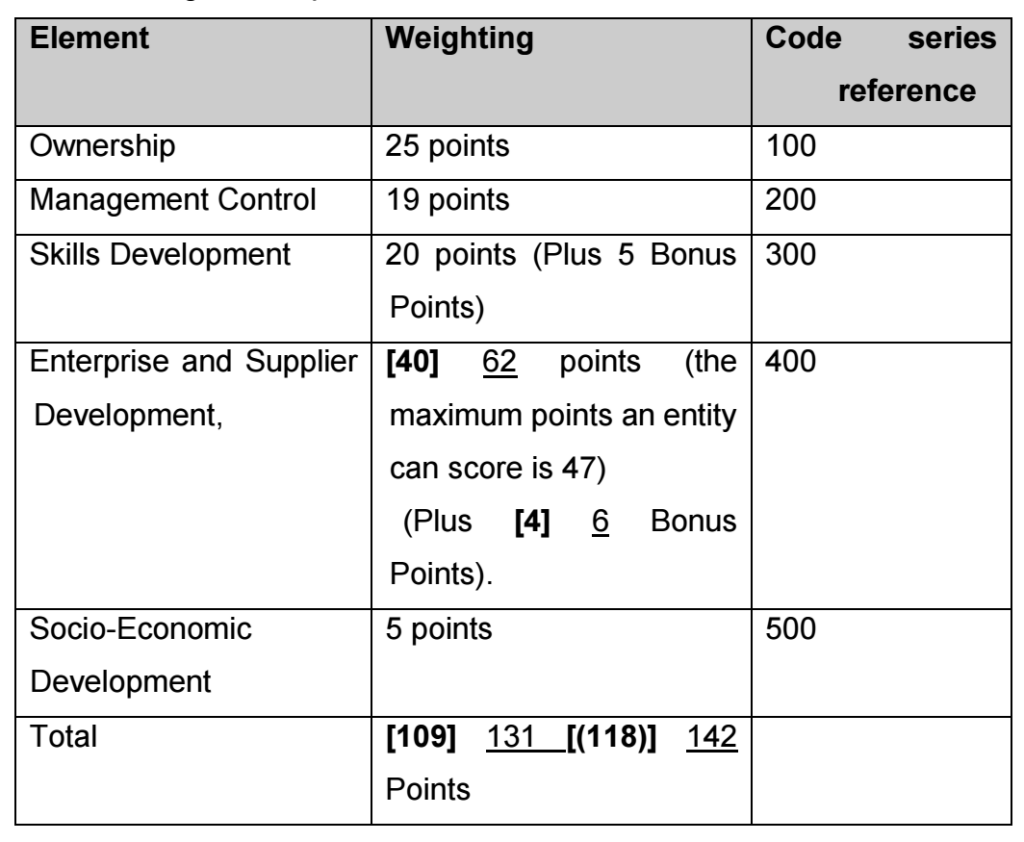
[ ] Words or numbers in bold type in square brackets indicate deletions from existing enactments.
_ Words or numbers underlined with a solid line indicate insertions into existing enactments.
9.2 B-BBEE RECOGNITION LEVELS
9.2.1 Based on the overall performance of a measured entity using the Generic Scorecard, Qualifying Scorecard, and Enterprise Scorecard, the measured entity will receive one of the following B-BBEE status uses with the corresponding B-BBEE recognition level:
- ENHANCED RECOGNITION FOR CERTAIN CATEGORIES OF BLACK PEOPLE
10.1 Throughout the codes, various criteria appear which advance the interests of certain categories of Black people. These include:
10.1.1 Black women should form between 40% and 50% of the beneficiaries of the relevant elements of the scorecard.
10.1.2 Black people with disabilities, Black youth, Black people living in rural areas and unemployed Black people form part of the beneficiaries of the relevant elements of the scorecard.